
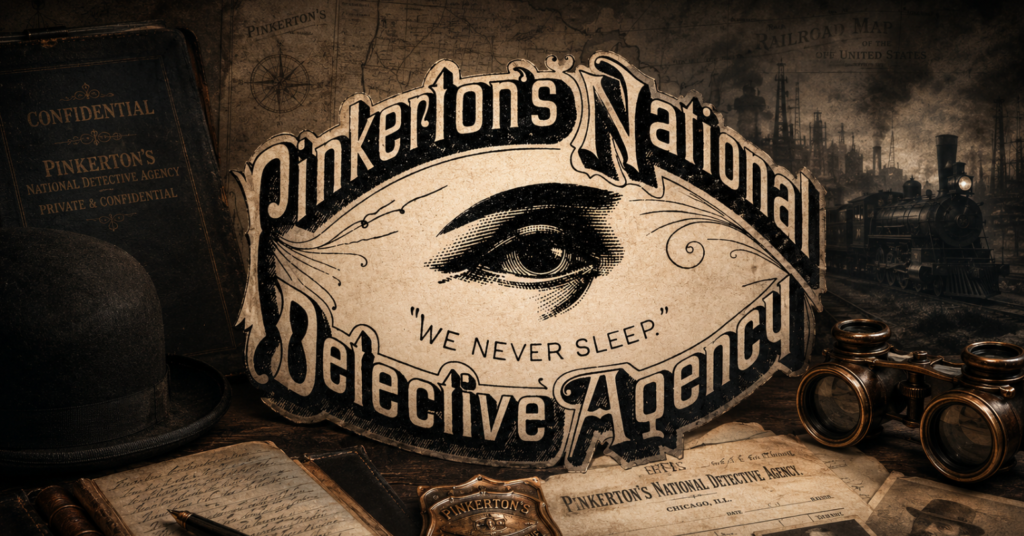
Have you ever felt like you were being watched? You’re not alone. Here’s the origin story of how the Pinkerton Detective Agency sold vigilance to American power and became the first private investigation agency.
Before surveillance became digital, it had a logo: an open eye and the promise, “We Never Sleep.”
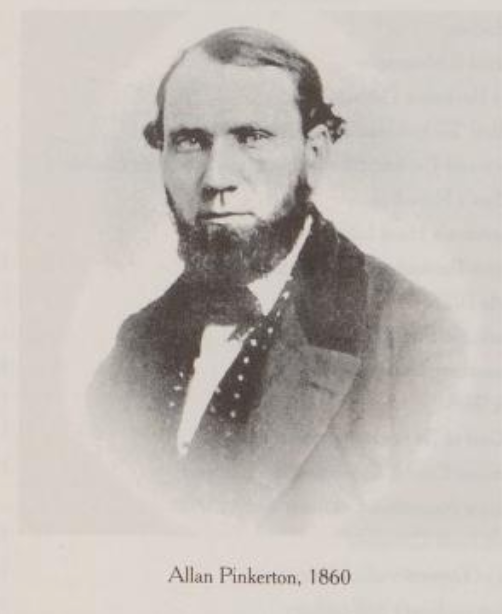
Allan Pinkerton, founder of Pinkerton National Detective Agency, did not just sell investigation.
He sold vigilance. Vigilance, by definition, is “the state of being keenly alert, watchful, and attentive, typically to detect danger, risks, or potential problems”. It implies continuous observation and proactive care to prevent issues, often described as maintaining a state of “constant vigilance”.
The agency’s open eye logo and motto “We Never Sleep” turned surveillance into a brand promise. Long before cameras watched street corners, before corporations monitored employee emails and risk-management firms sold intelligence dashboards to executives, the Pinkerton National Detective Agency built its power on a simple message:
someone is always watching.
Founded in Chicago in 1850 by Allan Pinkerton, the agency began as a private detective firm in a country that was expanding faster than its law enforcement systems could keep up.
Railroads crossed jurisdictions. Banks and express companies moved money across long distances. Counterfeiters, thieves, train robbers and fraudsters could slip through the cracks between local police departments.
Pinkerton stepped into that gap.
The agency offered what 19th-century America genuinely lacked: mobile, professional investigation. They pursued railroad thieves, investigated counterfeiting, protected trains and built a reputation for persistence.
The Library of Congress describes the agency’s records as documenting the work of “the oldest company of private investigators” and “containing rich primary material on American crime detection, corporate investigation and private security”.
But the same traits that made Pinkerton useful against criminals also made the agency useful against workers.
The agency’s promise was not simply that it could investigate. It could be hired. It could travel. It could operate quietly. It could gather intelligence for private clients. It could blur the line between public law and private interest.
That is where the Pinkerton story becomes less about detective work and more about power.
Because the open eye agency did not belong to the public… it belonged to whoever could pay for it.
The agency’s image was carefully constructed. The eye suggested alertness, discipline and moral certainty. “We Never Sleep” suggested protection. But to those being watched … labor organizers, strikers, immigrant workers, suspected radicals … the slogan meant something else entirely. It meant meetings might have informants. It meant a workplace dispute could become an intelligence operation.
Even the archive carries the aura of surveillance: Pinkerton kept what was referred to as a “secret archive” of major or interesting cases, a collection that later helped feed books, articles and the agency’s own legend. But the surviving record is partial and curated, by Mr. Pinkerton himself.
It reveals a great deal, while also reminding us that institutions often preserve the stories they want remembered.
Pinkerton was not just watching America. Pinkerton was helping write the story of what its watching meant.
In the heroic version, they were brave detectives hunting outlaws and protecting commerce. In the labor version, they were spies, strikebreakers and hired muscle. Both stories contain evidence. That is what makes the agency so historically powerful. It occupied the boundary between legitimate investigation and private coercion.
The open eye was not neutral.
It peered outward from the side of capital, law, property and order. But “order” is never a completely innocent word. It always raises the next question: whose order?
For railroad executives, Pinkerton order meant secure trains and protected cargo. For industrialists, it meant mills kept running. For banks, it meant thieves were caught and stolen money recovered. For workers, it could mean surveillance, intimidation and the arrival of strangers whose authority came not from democratic consent, but from a private and secretive contract.
The agency emerged in a country that had not yet decided how much policing power could be bought. It helped invent the modern private security landscape: the idea that risk could be managed, dissent could be monitored, labor could be infiltrated and power could protect itself through private eyes.
The Pinkerton eye did not merely see.
It warned.